

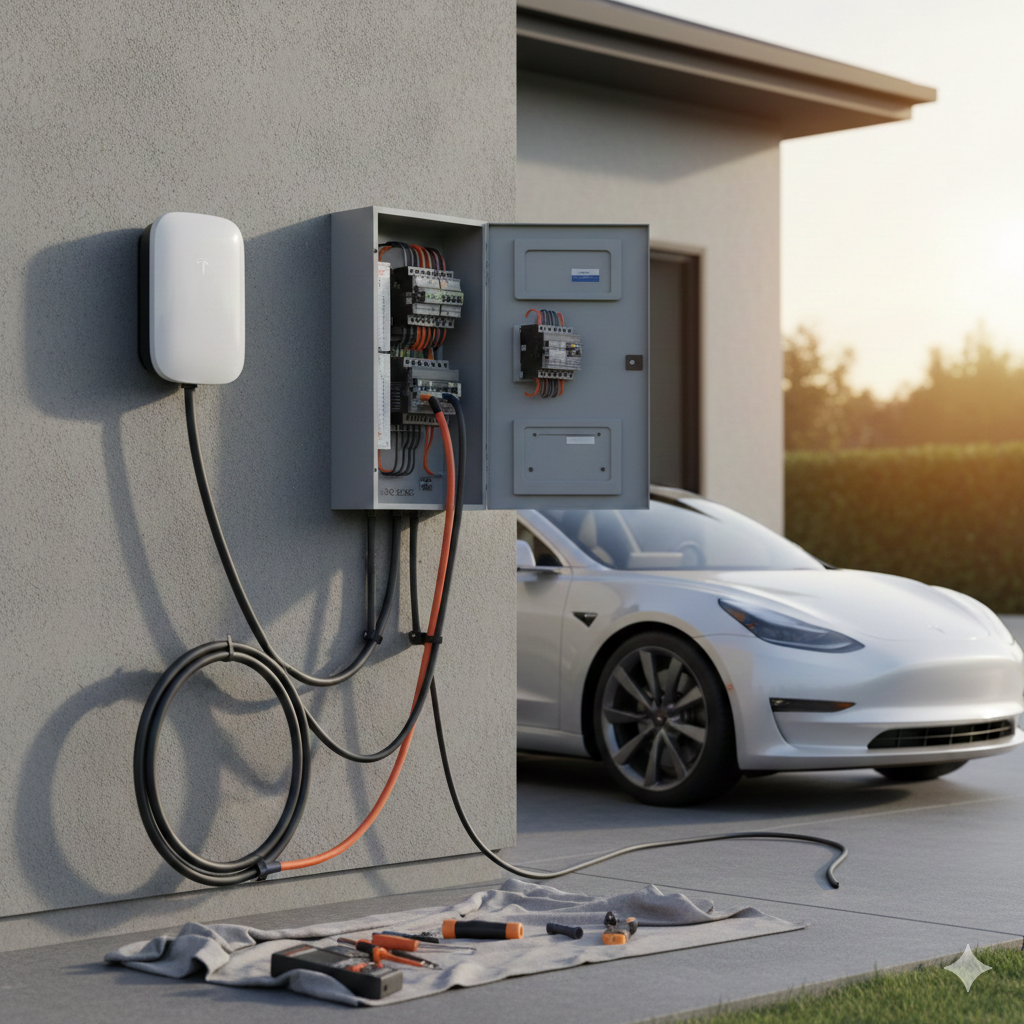

EV Charging Installation Near Me: Fast Local EV Charger Setup and Service
If you want an EV charging installed at home or work, you can find qualified local installers who handle site assessment, permits, and safe wiring—so you don’t have to guess what’s required. Start by checking certified installers and local services to get an accurate quote and timeline for a compliant, reliable installation.
EV Charging Installation Near Me You’ll learn how to evaluate installers, what questions to ask, and which permits or upgrades might affect cost and schedule, helping you move from research to a booked installation with confidence.
Understanding Local EV Charger Installation
You’ll learn the practical differences between charger types, how to match a charger to your property’s electrical capacity and parking setup, and what permits and safety rules typically apply in your area.
Types of Charging Stations
Home and public chargers fall into three main categories: Level 1 (120V), Level 2 (240V), and DC fast charging (400V+).
Level 1 uses a standard household outlet and adds about 3–5 miles of range per hour. It suits plug-in hybrids or occasional home top-ups where you have long parking times.
Level 2 requires a 240V circuit and delivers roughly 15–60 miles of range per hour depending on the vehicle and unit. This is the most common residential upgrade and the standard for workplace charging.
DC fast chargers (CHAdeMO, CCS) provide 60–400+ miles of range per hour and target commercial sites or transit corridors. They need three-phase power or high-capacity single-phase service and are costly to install.
When you compare units, check connector type, maximum amperage, hardwired vs. plug-in, weather rating, and smart features (Wi‑Fi, load management). Prioritize Level 2 for home and mixed-use sites unless you handle high turnover and can justify DC fast charging.
Assessing Home and Business Requirements
Start by checking your electrical panel’s available capacity and the service size (e.g., 100A, 200A). A Level 2 charger usually needs a dedicated 30–60A circuit; confirm spare breaker space or plan for a panel upgrade.
Measure parking layout: distance from panel to parking spot affects conduit/trenching costs. Outdoor parking needs a weatherproof, wall- or pedestal-mounted unit; covered garages allow more compact indoor models.
For multi-unit buildings, coordinate with building management about shared metering, load sharing, and tenant billing. Businesses should estimate daily turnover, average dwell time, and peak simultaneous plugs to size chargers and consider networked stations for billing and usage monitoring.
Factor in future-proofing: higher-amp circuits and conduit capacity reduce later retrofit costs if you add more chargers or faster units.
Permits and Safety Regulations
Local rules vary, but most jurisdictions require an electrical permit and inspection for new 240V circuits and hardwired chargers. Obtain the permit before installation to avoid rework and fines.
Installations must follow the national electrical code (NEC) or local code equivalents, including requirements for dedicated circuits, GFCI protection where applicable, and correct conductor sizing. Some areas require Arc-Fault Circuit Interrupter (AFCI) protection or load management systems for panels near capacity.
For commercial sites, accessible parking and signage must meet local zoning and accessibility rules. Keep documentation: equipment spec sheets, load calculations, and inspection certificates. Hire a licensed electrician familiar with local codes and utility interconnection rules to ensure safe, code-compliant installation.
Selecting Qualified Installers
You should prioritize verified credentials, transparent pricing, and reliable post-installation support when choosing an installer. These three factors determine compliance, safety, and long-term value for your EV charging setup.
Credentials and Certifications
Verify that the installer uses licensed electricians who hold the required local electrical contractor license or master electrician certification. Ask for proof of licensing and check it against your state or provincial licensing board; installers who can’t produce verifiable credentials are a red flag.
Look for manufacturer certifications (for example, Tesla, ChargePoint, or ABB) showing the crew has been trained on specific charger models. Also request evidence of insurance: general liability plus workers’ compensation. Confirm the insurer’s name and policy limits so you can cross-check with your insurer or property manager.
Finally, check for code-compliance knowledge. A qualified installer will reference NEC (in the U.S.), provincial codes (in Canada), or local utility interconnection rules and will pull required permits and inspection reports on your behalf.
Comparing Installation Costs
Get at least three written quotes that break down labor, materials, permits, panel upgrades, trenching, and any network activation fees. Compare line-by-line; a low headline price often omits costly items like meter relocation or a new subpanel.
Ask installers to itemize typical labor hours and hourly rates, and to list equipment make/model with warranty lengths. If an installer proposes a cheaper generic charger, note potential savings against long-term reliability and manufacturer support.
Clarify payment schedule and cancellation terms before work starts. Also request a written change-order process for unexpected issues discovered during installation so you won’t face surprise invoices later.
Warranty and Ongoing Support
Confirm both product and workmanship warranties in writing. Product warranties come from the charger manufacturer (commonly 2–5 years), while workmanship or installation warranties should be at least 1–3 years from the installer.
Ask whether the installer offers service-level options: remote monitoring, software updates, network onboarding, and emergency repair response times. If you need shared parking or multi-unit billing, ensure the installer supports networking, user management, and firmware updates required by your chosen system.
Finally, get contact details for post-install support and dispute resolution. A reputable installer will provide a clear process for warranty claims, parts replacement, and follow-up inspections.